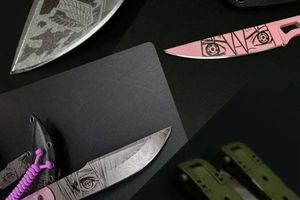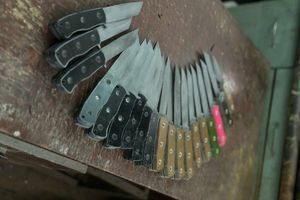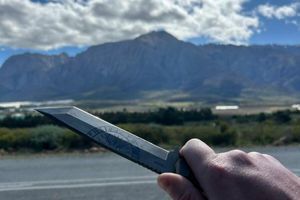

You are standing in front of a display case (or scrolling through an online store), and your eyes are darting everywhere. Aggressive "Tantos," predatory "Clip-points," daggers... Every knife looks cool, and every knife promises to be the best. But when you find yourself in a real forest, where you need to field dress game, slice food, and carve tent pegs, "cool looks" fade into the background. Only functionality remains.
Enter the Drop-point. It’s not just a blade shape; it is the "gold standard" in the world of hunting and bushcraft knives.
Why this specific shape? Why do experienced gamekeepers and survivalists most often choose this seemingly simple profile? Let’s break it down.
What is a Drop-point?
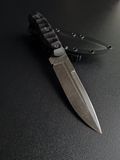
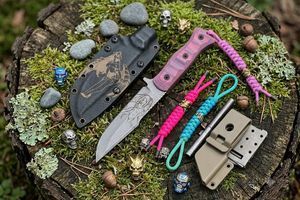
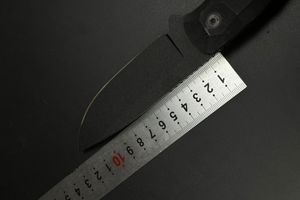
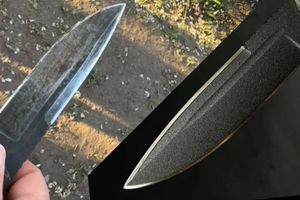
The name speaks for itself. In knives of this type, the spine of the blade slopes (drops) gently down toward the tip. The tip itself is not level with the spine but is positioned slightly lower, closer to the central axis of the blade.
It looks less aggressive than the predatory clip of a Bowie knife, but this very "modesty" hides powerful potential.


The Four Pillars of Drop-point Popularity
1. A Strong Tip — The Key to Longevity
In the forest, a knife is not a scalpel; it is a working tool. It is used to pry wood and bore holes in bone or timber.
Drop-point geometry provides the tip with the maximum thickness of metal. Unlike a Clip-point (where the tip is thin and delicate), a Drop-point withstands significant lateral stress. You can confidently dig splinters out of a stump without fearing that the tip of your knife will remain embedded in the wood.
2. Batoning Without Fear
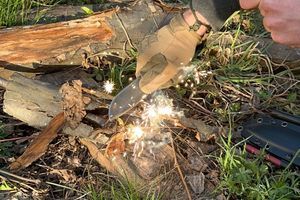
Bushcraft is impossible without fire, and preparing a fire often requires splitting logs with a knife (batoning). Here, the Drop-point is simply indispensable.
Because the spine drops gradually, the blade retains its mass and thickness almost to the very tip. This gives you a reliable surface to strike with a baton. The knife acts as a powerful wedge, and you don't risk snapping a delicate tip due to vibration, as often happens with thin Clip-points or knives with a false edge (swedge) on the spine.
3. The "Belly" for the Perfect Cut
Look at the blade from the side. You will see a long, smooth curve of the cutting edge, known as the "belly."
For a hunter, this is critically important. A large belly allows for skinning with long, smooth strokes without having to readjust the knife unnecessarily. The knife doesn't "tear" the material but glides smoothly over it. That is why the Drop-point is considered the best skinner among universal knives.
4. Control and Safety
Since the tip is lowered, it is closer to the line of force applied by your hand. This offers incredible control during fine work.
Moreover, for hunters, the lowered tip has another advantage: during field dressing, there is less risk of accidentally puncturing the internal organs of the game and spoiling the meat compared to working with a needle-sharp Clip-point.
Why Not a Tanto or a Dagger?
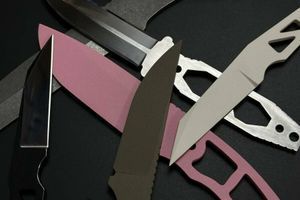
Beginners often choose the American Tanto for its "brutal" look. Yes, a Tanto is great for piercing car hoods (if you need to do that in the forest). But try peeling a potato or skinning game with it neatly — and you will understand why geometry matters. The angles of a Tanto interfere with a smooth slice.
Daggers are created for thrusting, not for work. They lack a comfortable spine to press down on with your second hand during a forceful cut, and batoning with them is impossible — you will ruin your baton on the top edge.
The Drop-point is balance. It doesn't specialize in just one thing; it does everything excellently.
Conclusion
When you choose a knife for life in the wild, you are choosing a partner that won't let you down.
The Drop-point is the choice of pragmatists. It is geometry that allows the same knife to chop a salad, field dress a boar, and baton wood for a campfire. That is why we at ProstaSTAL use this profile so often in our lineup — it simply works. No unnecessary flash, just maximum efficiency.