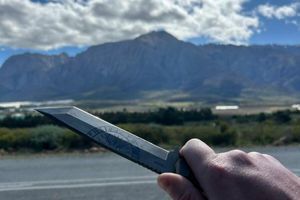

In every man's life, there comes a moment of force majeure when time is against you, and there are no proper tools at hand. For a military operator, it might be a mud-caked ammo crate; for a civilian, a jammed door in a technical room or a need to urgently pry off some planks. It is in this exact moment that the irresistible temptation arises to use the blade as a lever to pry and break through the obstacle. No crowbar, no pry bar. Just him — your trusty knife on your belt.
Instinct whispers: "Stick the tip in and push." Experience screams: "Don't do it!"
Where is that fine line beyond which a reliable steel friend turns into two pieces of scrap metal? Let’s break down the physics of the process and find out if a tactical knife can be used as a crowbar.
Anatomy of the "Snap": Why Do Knives Break?
Let's start with an axiom: A knife is created to cut. Its geometry is a wedge, sharpened for penetration and separation of material. A crowbar is a lever, created for brute force.
When you use a knife as a lever, you enter a battle with the laws of physics, and they often win.
Weak Point #1: The Tip
The most common death of a knife is 1-2 cm of the tip snapping off. Why? Because under lateral load (when you are prying something), the entire force of your arm, multiplied by the length of the lever (handle + blade), concentrates on a tiny cross-section of metal near the point.
No steel in the world likes such loads. The exception is the tactical Tanto knife, whose geometry is specifically reinforced for piercing and rough work, but even it has its breaking point.
Weak Point #2: The Transition Zone (Ricasso)
If you drive the knife in deep and lean on it with your whole body, it might snap near the handle. However, this applies mainly to hidden tang (rat-tail) construction. With a Full Tang knife, this happens extremely rarely, unless the steel is over-hardened.
Full Tang — Your Insurance Policy
This is where the Full Tang construction (where the tang runs through the entire handle and has the same thickness as the blade) shows its superiority. Therefore, when you decide to buy a handmade tactical knife, pay attention primarily to the integrity of the construction.
A tactical full tang with a thickness of 4-5 mm (the standard for ProstaSTAL knives) is essentially a sharpened steel plate. Breaking it in the middle with bare hands is almost impossible. It might bend (permanent deformation), but to tear apart 5 mm of D2 (Kh12MF) steel, you need superhuman strength or a vice and a pipe.
So, if you have a full tang, you already have a head start. But how to use it?
Safety Guidelines: If You "Must" and There is No Choice
We do not recommend using a knife as a crowbar. But we are realists. If the situation is extreme and the success of the mission or survival depends on it, do it right.
Rule 1: Forget the Tip
Never pry with the very tip. This is a guaranteed break. How to do it: Drive the knife into the gap as deep as possible, preferably closer to the heel of the blade (the part of the blade near the handle). The metal cross-section is thickest there.
Rule 2: Vector of Force
Do not make sharp jerks. Steel, especially hard steel (59-60 HRC), does not like shock loads on bending. How to do it: Apply pressure smoothly, controlling the effort. If you feel the blade starting to spring but the object doesn't yield — stop. You have reached the elastic limit. Next comes either a bend or a snap.
Rule 3: Load Distribution
Pry with the "spine," not the cutting edge, if possible. This will save your edge.
Bushcrafter's Hack: The Smart Lever
The best way not to break a knife during heavy work is not to use it as a lever directly.
Use the rule: "The knife creates the tool." Instead of shoving an expensive blade under a heavy log or crate:
-
Find a sturdy branch or piece of wood.
-
Use the knife to whittle it into a wedge.
-
Drive this wooden wedge into the gap.
This way, you transfer the load to the wood. If the wedge breaks, you make a new one in 2 minutes. If the knife breaks, you are left without a weapon and a tool.
Conclusion
A quality military knife with a thickness of 4-5 mm made of the right steel (tough and strong, like D2/Kh12MF) can withstand colossal abuse. It can open a tank hatch if you act with intelligence.
But remember: the strength of a knife is your emergency reserve. Do not waste it on trifles. A knife is an extension of your hand, not a replacement for a crowbar.
Take care of your blades, and they will save you when it is really needed.