
The autumn forest, the smell of damp leaves, the morning mist, and that moment of triumph when a brown cap of a Porcini peeks out from under the moss. In "mushroom hunting," there is no adrenaline of the chase, but there is a philosophy: attentiveness, calmness, and respect for nature.
And so you lean down to your find. Your hand reaches for your belt... And there is a massive knife that looks more suitable for chopping firewood than for jewelry-like work. is it convenient to cut a delicate mushroom stem with it? Hardly.
Mushroom picking has its own specifics, which dictate clear requirements for gear. Let's figure out why a mushroom knife is a separate tool and what characteristics make it ideal.
Main Rule: Scalpel, Not an Axe
A mushroom does not require brute force. It does not need to be chopped or split. It just needs to be cut.
If you go into the forest with a knife that is too thick, you will face a problem: a massive spine will simply break the fragile mushroom stem, turning it into crumbs instead of a neat cut.
A quality mushroom hunter's knife has:
-
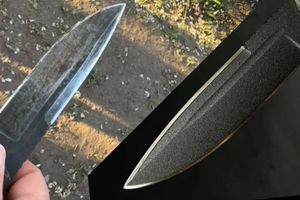
Thin Spine. The blade should pass through the flesh like butter, creating no resistance.
-
Thin Edge Geometry. So that the cut is surgically clean and does not damage the mycelium.
Geometry: "Claw" or Classic?
There is a specialized blade shape for mushroom pickers — the Hawkbill (hawk's beak). This is when the blade is curved inward.
-
Pro: It is very convenient to cut the stem in a circular motion, as if embracing it.
-
Con: It is only good for cutting mushrooms. Slicing food at a rest stop with such a "sickle" is uncomfortable.
Therefore, we advise stopping at a small Drop-point or Straight-back. These are universal fighters: cut a mushroom, and whittle a stick to push aside leaves.
Safety and Comfort: Mushroom Knife with a Sheath
This is a critically important point. You are constantly moving, bending over, making your way through bushes. The knife should not dangle in a pocket or, even worse, in a basket with mushrooms (where you can cut yourself).
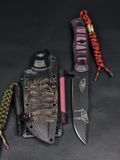
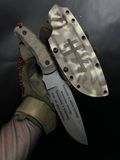
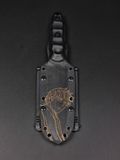
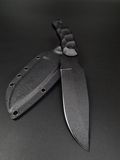
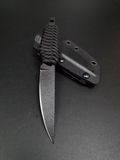
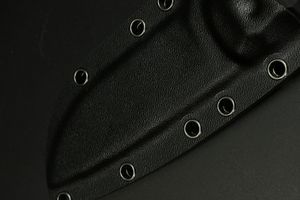
The right mushroom knife with a sheath solves these problems. The classic carrying option is on the belt, but the sheath must securely fix the knife so you don't lose it when stepping over fallen trees.
Size and Color: Why Camouflage is Evil
Imagine: you found a clearing of chanterelles, cut a full basket, sat down to rest, and put the knife next to you in the grass. Distracted for a minute, you look around... and the knife is gone.
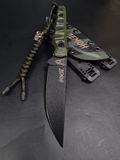
If you have a knife of a protective color — congratulations, you most likely won't find it. In the forest floor, green and brown colors disappear instantly.
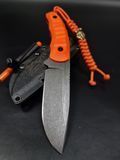
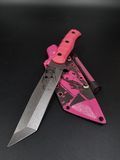
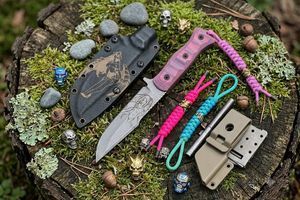
Rule #1: The handle must "scream." Orange, bright yellow, acidic green. The knife should be visible from 5 meters away in tall grass.
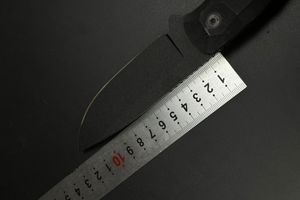
Rule #2: Compactness. You don't need a long blade. For most mushrooms, 7–12 cm of blade is enough.
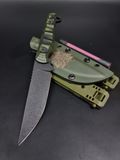
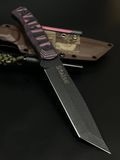
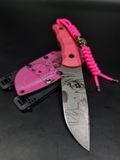
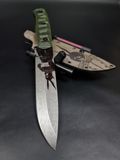
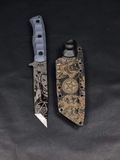
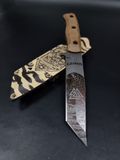
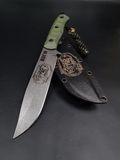
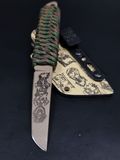
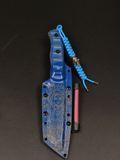
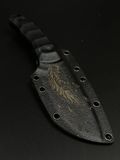
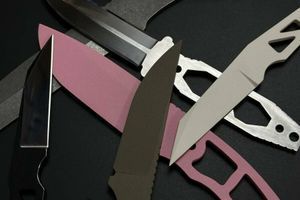
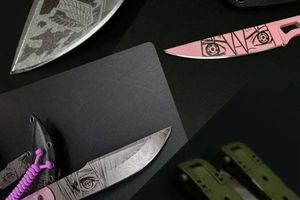
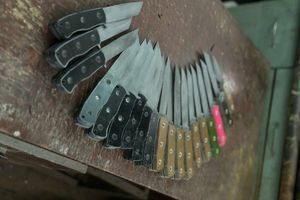
That is why in the ProstaSTAL lineup we have compact skeleton knives and small models that fit perfectly into this niche. They are light, bright, and often come with convenient sheaths.


Steel: Moisture is the Main Enemy
Mushroom juice is aggressive, and conditions in the autumn forest are always damp. Carbon steel will quickly become covered with spots here.
For mushroom hunting, stainless steels are ideal (for example, N690, 440C, or properly treated D2/Kh12MF). But remember: it is NECESSARY to wipe the knife dry after each use and regularly care for it. This will prolong the life of your tool.
The "Brush" at the End: Show-off or Necessity?
Classic mushroom knives often have a brush on the end of the handle. This is not decor. An experienced mushroom picker cleans the trophy on the spot. Cut — brushed off the earth and pine needles — put the clean mushroom in the basket. This saves hours of work in the kitchen at home.
Conclusion
The ideal tool for the forest is not necessarily something big and scary. A mushroom knife should be:
-
Light and compact.
-
Thin and very sharp.
-
Have a convenient sheath for safe carrying.
-
Be bright so as not to get lost.
Take a precise tool that will turn the harvest into a pleasure. At the ProstaSTAL workshop, we know that there is a blade for every task. Protect nature and may your basket always be full!