
Anyone who has ever tried to light a fire after a long rain knows that moment of despair: the matches catch, the lighter works, but the wet wood only hisses and releases acrid smoke. In that moment, you realize that success doesn't depend on luck, but on a clear understanding of how your tool and your material work together.
The art of making a feather stick is a core skill that transforms your knife from a simple pry bar into a precision engineering instrument. It is the most reliable way to reach the dry core of a branch and increase its burnable surface area by dozens of times.
Principle of Operation: Calculation Instead of Hope
The problem with a wet forest is that water only permeates the outer 2–5 mm of the wood. Inside, beneath this damp barrier, the wood remains dry and ready to burn. The goal of "feathering" is not just to expose this core, but to maximize the surface area in contact with oxygen.
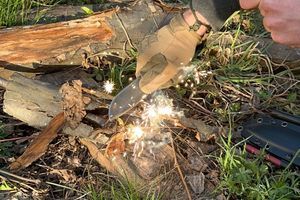
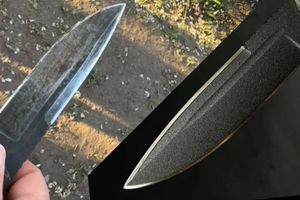
The thinner the "petals" you carve, the lower their heat capacity—meaning they require less energy to reach their ignition temperature. This is a true test of your survival knife: it must be sharp enough to shave micron-thin layers of wood and stable enough that you don’t slip and hack off the entire shaving in one go. Every thin curl becomes ideal fuel that will ignite from the smallest spark of a ferro rod.
Anatomy of Control: Why the Handle is Critical for Precision Work
When making a feather stick, you are performing very fine, controlled work. Your fingers might be numb from the cold, or your hand might be wet from the rain. In these conditions, the material and ergonomics of the handle come to the forefront, ensuring safety and the precision of every stroke.
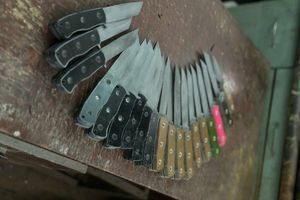
Unlike lacquered wood or cold plastic, Micarta becomes "tacky" and grippy specifically when it gets wet. It provides the tactile feedback that allows you to feel every millimeter of the blade's depth in the wood. If you choose to buy a bushcraft knife with a Micarta handle, you gain full control over the blade pressure, which is critical for the perfect shaving. We discussed in detail why this material is far superior to any exotic wood for a working tool in our article.
How to Prepare the Perfect Feather Stick:
-
Find "Dead" Wood: Look for dry coniferous branches that are snagged in bushes and not touching the ground.
-
Remove the Moisture: Use your hiking knife to shave off the wet bark and the upper layer of wood until you reach the bone-dry core.
-
Positioning: Brace the end of the stick against a stump or the ground. Grip the knife firmly but without unnecessary tension.
-
Long and Smooth Strokes: Start shaving thin curls from top to bottom, but do not complete the cut—the shavings must remain attached to the stick, forming a "curly" head.
-
The Angle: Experiment with the angle of the blade. If the blade bites too deep, you get chips. If it glides too easily, you get dust. You are looking for the "sweet spot" in the middle.
More Than Just Fire Lighting
Being able to prepare proper kindling in difficult conditions is, above all, about confidence. When it's raining and cold, and you feel the blade obediently taking off thin shavings, you regain control over the situation. In moments like these, a knife is primarily a functional tool that allows you to get a result without unnecessary fuss.
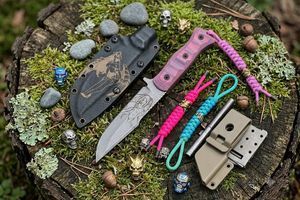
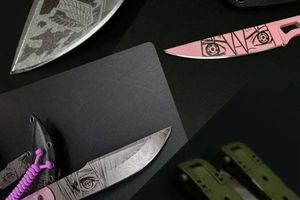
This is precisely why personal inscriptions and engravings often appear on blades: home coordinates, important dates, or phrases that have meaning only to the owner. This isn't decoration; it’s a way to make a workhorse tool "your own," adding character to it. When you light a fire with a knife that has seen many treks with you, you know exactly what it’s capable of.
Conclusion
Buying a bushcraft knife is only half the battle. Real mastery comes from understanding what your steel can do. The feather stick is the best practice for learning to "hear" your knife.
Remember: in any unstable situation, heat is your primary resource. And a reliable handmade knife with the right geometry is the minimum requirement to guarantee you can secure that heat.