
Twilight in the old forest falls abruptly, like a heavy, wet blanket. You feel the cold rain gradually turning your knife's handle into a slippery piece of soap. Your palms are weary, your fingers numb from hours of work, and there’s still firewood to gather for the night. You take a swing to lop off a dry branch, and at that moment, reality slows down: the knife slips.
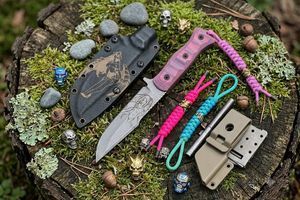
In this split second, the fate of your trip is decided. Whether your tool flies into the black maw of a marsh or remains in your grasp depends on a single piece of paracord. What is a lanyard? It’s not just a decoration. It is a vital link between you and your survival.
The Wrist Trap: Safety Lessons Among the Thickets
Imagine that, out of habit, you’ve slid your hand through the lanyard loop and tightened it around your wrist. It feels as if the knife is now "chained" to you. But the forest does not forgive illusions. During a heavy strike, the blade might get stuck in the wood while your hand continues to move by inertia.
If the hand is rigidly fixed at the wrist, the knife turns into an uncontrollable propeller — the so-called "nunchuck effect." One jerk, and the sharp steel meets your forearm. Furthermore, if you trip over roots and begin to fall, you won't be able to instantly discard the knife to put out an empty palm for protection.
So, how do you hold it correctly? True woodsmen use the lanyard as a lever. Pass the cord over the back of your hand or hook it around your thumb. This creates tension that "glues" the handle into your palm but leaves the ability to instantly drop the knife just by opening your fingers. This method is known as the Thumb Loop. Yet, even the most reliable grip can fail when another unpredictable element enters the game.
Dancing Over Water: When the River Wants its Due
The adventure becomes even more perilous when you find yourself on slippery rocks in the middle of a rushing stream. You need to cut a rope or strip bark from a support stick, while the water roars and spray hits your face. In such conditions, a knife is the first thing the elements want to take.
If the tool falls into a murky stream, the chances of finding it are near zero. However, a bright paracord lanyard acts as a rescue buoy. Even underwater, the long tail of the cord flutters, indicating the location of your helper. And if the knife is swept under a fallen tree, you won't have to dive into the icy water — simply hook the loop with a common branch.
A solid lanyard bead becomes your ally here: due to its weight, it pulls the cord tail through the current, preventing it from tangling and helping you snag the tool faster. But the real test begins when you lose not just your grip, but the ability to see your tool clearly.
A Tactile Anchor: The Touch in the Dark
When the night finally wins and you are working almost blindly, or when your hands are tucked into thick winter gloves, the "feel" of the tool vanishes. You can no longer sense where the handle ends and danger begins.
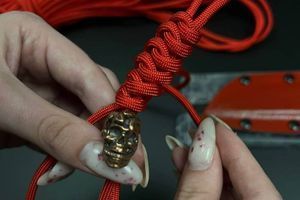
At this moment, your pinky finds the square paracord lanyard. Its rigid edges and textured weave give your brain a clear signal regarding the knife's position. The bead for paracord at the end of the weave serves as a natural stopper. It allows you to shift your grip to the very bottom, extending the "chopping arm" while remaining certain that your hand won't slip onto the blade.
Create Your Symbol of Reliability
Bushcraft is a philosophy where every piece of gear must be flawless. If you decide to buy a lanyard for a knife, you are choosing more than an accessory; you are choosing a knot you can trust with your comfort.
At the ProstaStal workshop, we know the value of every inch of paracord.
-
We will weave a lanyard for you using square or round patterns.
-
You can choose unique lanyard beads that add balance to your knife.
The forest does not tolerate neglect of details. Arm your knife with the right insurance, and it will return with you from every journey.
What story will happen to you next time? Be ready for anything together with ProstaStal.