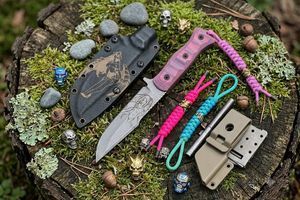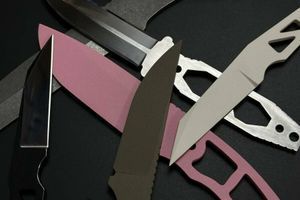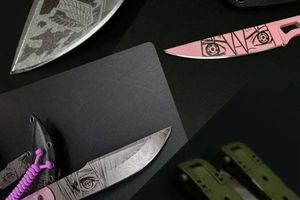

Even the most expensive knife made of premium steel will turn into a useless piece of metal in your hands if its geometry is chosen incorrectly. It is this misunderstanding of cutting physics that spawns endless debates between fans of the "indestructible" Scandinavian grinds and adepts of the delicate slice from the spine. A beginner gets lost in terms, buys the first knife they see, and then wonders: why does an expensive blade split an apple instead of slicing it, or why does it "skate" over dry wood? Today we will explain the difference in geometry so you clearly understand what the Scandi grind is created for, and where the potential of Flat grinds is revealed.
Angle of Attack: What is the Difference?
Before talking about work, let's look at the blade profile.
Scandi Grind
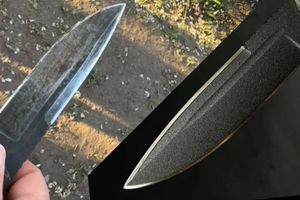
The severe classic of the North. The grinds start from the middle (or lower third) of the blade and go in straight lines to zero. Main Feature: Absence of a micro-bevel. The cutting edge is formed directly by the intersection of the grinds themselves. It is, in essence, a razor-sharp chisel.

Flat Grind (Full Flat Grind)
The geometry that dominates among universal knives and in hunting grounds. The grinds start from the very top (the spine) and taper smoothly to the bottom. But at the very end, there is a micro-bevel (secondary bevel) — that same small edge that you hone with a sharpening rod. Main Feature: The blade becomes thinner gradually, turning into a delicate wedge for deep penetration.

Woodwork (Bushcraft)
You are in the forest. You need to whittle stakes or make a "feather stick."
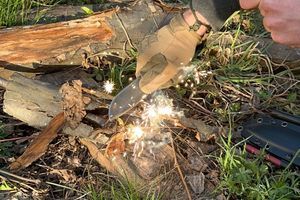
Here, Scandi grinds demonstrate their superiority. They work like a hand plane: you lay the wide flat surface of the grind on the wood and control the angle perfectly. The knife bites into the wood aggressively, with that satisfying crunch. It is controllable and predictable during forceful carving.
Flat grinds are less convenient for this task. Due to the presence of a micro-bevel, you have to "catch" the angle by hand. The knife often "skates," slipping over the bark, or conversely, digs in too deep, making it difficult to control the thickness of the shaving.
Verdict: If your goal is camp construction, Scandi will be significantly more effective.
Meat and Food
Game has been hunted (or sausage pulled from the backpack). Time to cut.
In this discipline, the Scandi grind falls short. Due to the abrupt transition in thickness, it works like a splitting wedge: it doesn't slice hard apples or carrots, it splits them. In viscous material (meat, lard), the wide bevels create excess friction, making it harder for the blade to pass through.
In contrast, Flat grinds from the spine work like a "laser." The blade enters the material softly, meeting almost no resistance. When field dressing, such a knife easily separates membranes and makes long, precise cuts without getting stuck in tissues.
Verdict: For hunting and food prep, Flat grinds are the undisputed leader.
Field Sharpening
The knife is dull. It's getting dark, hands are frozen.
Here the key feature of Scandi grinds is revealed. You don't need to be a sharpening sensei and hold a microscopic angle. You simply lay the knife with the entire flat of the grind on the stone and move it back and forth. The grind itself serves as a guide, so it is almost impossible to ruin the edge geometry.
With Flat grinds in field conditions, it is more difficult. You need to intuitively maintain the angle of the micro-bevel. If your hand is tired or frozen, there is a risk of missing the angle and "rounding" the cutting edge instead of restoring sharpness.
Conclusion: So What to Choose?
The universal knife does not exist; there is the right tool for the task.
-
Choose Scandi Grinds if you are a bushcrafter. Forest, fire, shelter, woodwork — this is its element. Plus, ease of maintenance in any conditions.
-
Choose Flat Grinds if you are a hunter. You need a high-quality, "tasty" cut on meat and food. It will whittle wood too, but without that same pleasure.
At the ProstaSTAL workshop, we don't argue about tastes. We just make knives that work. Choose the geometry for your tasks.