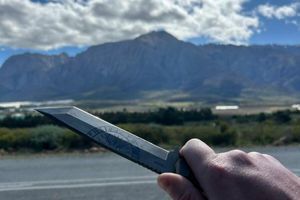

Anatomy of a Tactical Knife. Part 2: Handle, Sheath, and Hidden Details
In the first part, we dissected the "hardware" — blades, steel, and geometry. But a knife is a tool operated by a human. The handle is 50% of a knife's success. If it's not perfect, all the power of the blade will be useless.
Today we talk about ergonomics, sheaths, and the small details that turn a piece of steel into a reliable partner that won't let you down in a critical moment.
1. Micarta: Why aren't handles smooth?
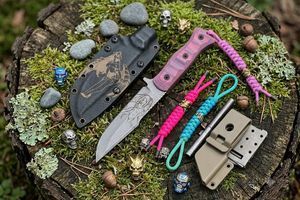
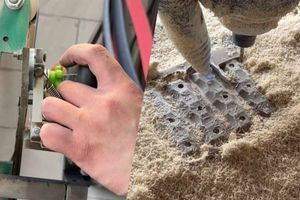
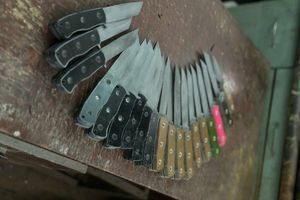
Have you noticed that the handles of high-quality tactical knives are usually rough or have a fabric-like pattern? This is Micarta — a unique composite material made from layers of fabric. Read more
- Most interesting fact: Micarta has a unique property — it becomes less slippery when wet. The microfibers of the fabric rise with moisture. If your hand is sweaty, bloody, or the knife falls into water, the grip on your palm only increases, unlike lacquered wood or smooth plastic.
2. Anatomical Profile: The Handle Takes the Shape of the Hand
The handle is 50% of the knife's success. Engineers design it not just as a holder, but as an extension of your hand's anatomy.
- Anatomical Shape: A proper handle has no sharp corners and literally "flows" into the palm, repeating its curves. This relieves fatigue during long, forceful work and gives a sense of unity with the knife.
- Reverse Grip Control: Look at the butt of the knife. Often it has a beveled shape or special notches. In a reverse grip (blade down), the thumb rests exactly on the butt of the handle. This allows for powerful strikes without fear that the knife will fly out of your fist.

3. Guarda: Your Safety Above All
A guard is a protrusion between the handle and the blade. In tactical models, it is often an integrated part of the Full-Tang construction.
- Finger Protection: The main function is to prevent your hand from slipping onto the sharp blade during a strong thrust or work with hard materials (e.g., wood or plastic).
- Additional Leverage: Helps to better control the knife during forceful cuts "away from yourself".
- Psychological Comfort: Working with a knife that has a reliable guard is much more confident and faster, as you don't think about the risk of cutting your own palm.

4. Jimping (Notches on the Spine)
Jimping is a series of small notches on the spine (top part) of the knife where the thumb usually rests in a standard grip. What is it really for?
- Reliable Fixation: Imagine your hands are in oil, grease, blood, or you are wearing thick tactical gloves. Without notches, the thumb will simply slip under strong pressure. Jimping creates the necessary friction ("brakes").
- Forceful Cut: It is through these notches that you transfer the effort of your whole body to the blade when you need to cut something very dense (e.g., thick rubber, hose, or wood).
-
Batoning: When a Knife Replaces an Axe
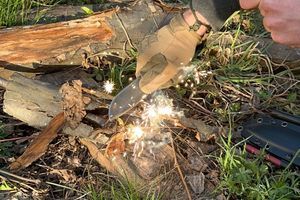
You are in the forest, you need to start a fire, the wood is wet, and there is no axe. With a fixed-blade knife (especially with a saber grind), you can perform batoning — splitting thick logs by striking the spine of the knife with another piece of wood.
- Reliability: A folding knife would fall apart from such impacts (the lock would fail). A fixed blade (Full-Tang) will take this load calmly. This is the only knife with which you can build a full-fledged shelter without additional tools.

5. Choil: A Small Notch with a Big Mission
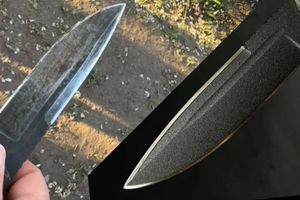
A choil is a semi-circular notch at the base of the blade before the handle. Many mistakenly think that because of it, the knife "loses" useful cutting edge length.
- Precision Grip: The choil allows you to place your index finger directly on the blade (past the guard). This shortens the "lever" and allows for extremely precise work: skinning, whittling small pegs, or opening packages without damaging the contents.
- Sharpening Ease: It technologically separates the cutting edge from the heel of the knife. This allows you to sharpen the blade along its entire length on a whetstone without scratching the handle or guard.

6. Lanyard Hole: Not Just for Looks
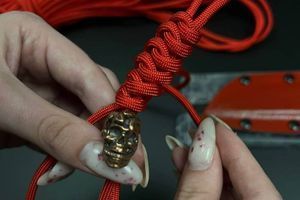
The hole in the back of the handle is needed not only to hang a stylish paracord bead there.
- Quick Draw: In thick gloves or in the dark, it is hard to fumble for a flat knife handle in a pocket. But by grabbing the paracord "tail" (lanyard), the knife flies out of the pocket or sheath in a split second.
- Extended Leverage: If the knife is compact and you need to chop something, you can grab the lanyard (shifting your grip back), which shifts the center of gravity. The strike becomes three times stronger (flail effect).
- Safety: A loop of paracord is thrown over the wrist. If the knife slips out of your hands while working at night, in water, or at height — you won't lose it. Read more

7. ABS Plastic: Sheaths That Don't Rattle
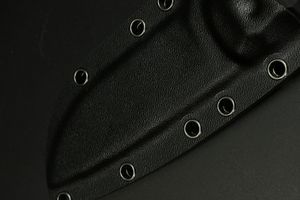
Old hunting knives were carried in leather. Leather is beautiful, but it gets wet, rots, stretches, and most importantly, the knife can fall out while running. The modern tactical standard is ABS plastic.
- Phenomenal Impact Resistance: ABS plastic springs and dampens impact. If you drop Kydex sheaths on frozen concrete, there is little risk of cracking. ABS plastic withstands extreme loads, fearing neither -40°C nor scorching sun.
- Dead Lock: Sheaths are molded to a specific knife. It enters with a characteristic click and holds dead tight. You can mount the knife on a vest handle-down (for a faster draw) — and it will never fall out on its own, no matter how much you jump or crawl.

8. Mounting: MOLLE System
For fixed-blade knives, the method of carrying is critical.
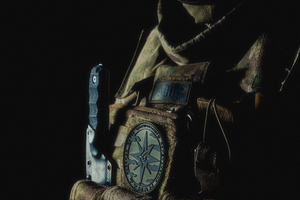
- MOLLE Compatibility: This is a full-fledged modular system. Special slots and straps on the sheath allow you to mount the knife at any angle and in any place: on a load-bearing vest, on a backpack strap, on a plate carrier, or on the thigh. The knife is always where it is convenient for you.
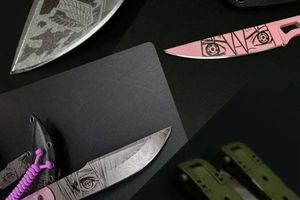
9. Color Solutions: Why Not Only Black?
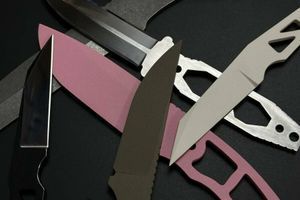
A tactical knife does not necessarily have to be black. Recently, colors like Tan (sand), Olive, or even Orange have become popular.
- Camouflage: Sand and green shades perfectly mask the knife against military gear (MultiCam) or nature.
- High-Visibility (Bright): This is a "civilian" tactical approach. If you drop the knife in thick grass, water, or snow during a hike, a bright color (orange, yellow) will help you find it. In the forest, this can save the tool from being lost.

Knowledge is Safety
Understanding your tool makes your work with it more efficient and confident. Every hole and every angle is dictated by the engineering necessity to survive and complete the task.
Now, when choosing a knife, you will look not only at its shine but also at the presence of the right notches, grind geometry, or a proper choil. Because these very details turn a piece of steel into a silent partner ready for any challenges with you.
At ProstaStal, we curate our assortment so that every detail works for you.
Choose a Smart Knife