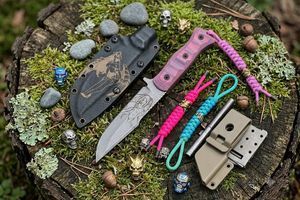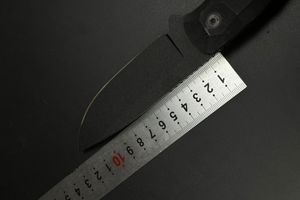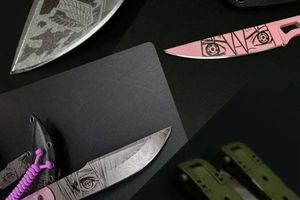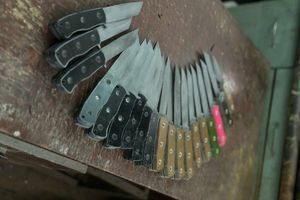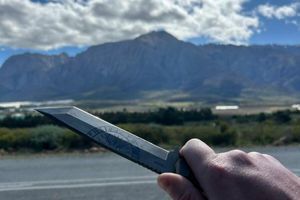

When you buy a quality knife, like our tactical Tanto or the bushcraft Yarchuk, you get a complete tool. But there is one detail that often raises questions for beginners: "Why is there a cord with a bead dangling from the handle?"
Many consider a knife lanyard to be just an aesthetic addition, a mere trinket. This is a mistake. In professional use, from military personnel to foresters, a lanyard is as functional an element as the belt clip on a sheath. It is "tuning" that expands the capabilities of your blade.
Here are 5 non-obvious but critically important functions of a lanyard that will make you look at this accessory differently.
1. "Quick Start": Instant Extraction
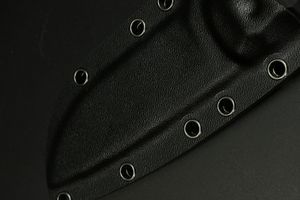
If you use our knives, you know: we make plastic sheaths that fix the knife "dead tight." To get it out, you need a confident, sharp effort.
When a knife sits deep in a sheath or in a pocket, grabbing it by the handle can be difficult, especially in gloves or a stressful situation. A paracord lanyard solves this problem. It sticks out like a "tail." You simply pull on it, and the knife jumps into your hand. This saves fractions of a second that sometimes decide everything.
2. Handle Extension
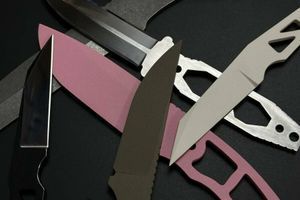
This is especially true for compact knives or skeleton knives, where the handle might be a bit too short for your palm.
A rigidly woven lanyard using a "Snake" or "Square" knot effectively adds 2-3 centimeters (about an inch) to the handle length. This allows you to fully rest your pinky finger against the lanyard, achieving a secure full-palm grip. You get the compactness of a small knife with the convenience of a large one.
3. "Chopping Grip": More Inertia
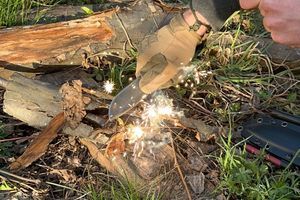
For bushcraft knives like the "Yarchuk," a lanyard unlocks new mechanical possibilities. If you need to chop through a branch, you can shift your hand to the very end of the handle, holding the knife virtually by the lanyard—either by sliding your fingers through it or using it as a backstop.
This shifts the center of gravity forward and increases the leverage. The strike becomes significantly more powerful, like that of a small hatchet. Without a lanyard, such a trick would end with the knife flying out of your hand into the bushes (or worse, into your leg).
4. Visual Beacon: Don't Lose It in the Grass
Imagine: twilight, you are in the forest, you put your knife on the grass... and it vanished. Dark Micarta, camouflage, or black tactical coatings are great for concealment but terrible for finding your tool.
A lanyard made of bright paracord—for example, safety orange or neon green—or featuring a contrasting lanyard bead works as a beacon. It unmasks the knife for you but does not interfere with its operation. This is your insurance policy against losing an expensive instrument.
5. Balance and Aesthetics: The Role of the Bead
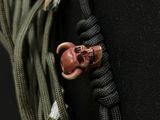
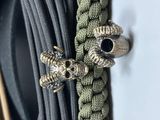
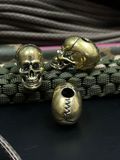
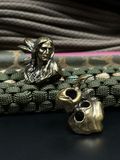
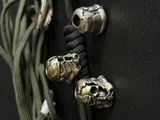
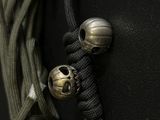
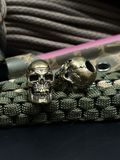
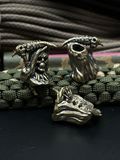
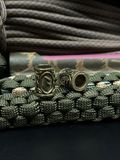
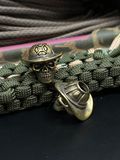
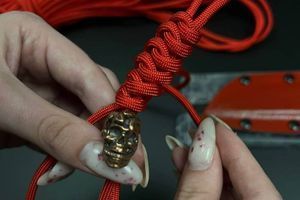
Why do we add metal beads? It's not just for beauty, although a bronze skull or a rune looks cool on a knife.
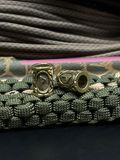
A knife bead acts as a counterweight. It adds weight to the free end of the lanyard, forcing it to hang straight down under gravity rather than sticking out in different directions. This makes it easier to extract the knife from a pocket—the lanyard is always "at hand."
Furthermore, a bead is a method of personalization. Your knife becomes unique. We offer beads with Scandinavian runes, stylized Japanese motifs, and many others to match your style.

A knife without a lanyard is like a warrior without armor: it will handle the job, but with it, it is more effective.
At the ProstaSTAL workshop, we don't just tie knots. We select the paracord and hardware so that they perfectly complement the character of your knife. You can order a custom lanyard with a unique bead right now.