
Some tools do more than serve — they protect, save lives and help you survive. A combat knife is one of them. You will find it on a soldier's vest at the front, in a scout's pack in the mountains and on the belt of a hiker making their way through the forest. But what exactly makes a knife a combat knife, and how do the different types differ? In this article we go beyond a simple list: for each type we explain its purpose, shape and history, and why it matters.
What is a combat knife?
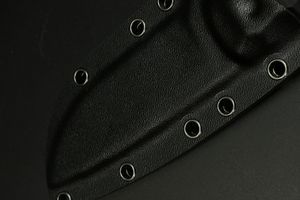
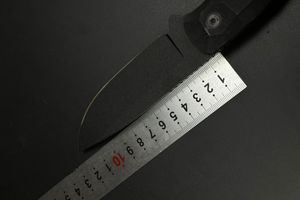
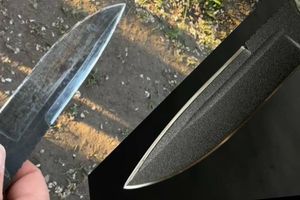
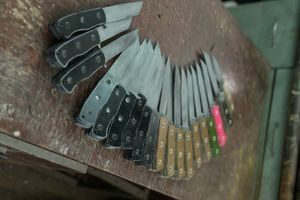
A combat knife is a fixed-blade knife built for military use — both as a close-quarters weapon and as an everyday field tool. Most combat knives share the same traits: a strong fixed blade, usually 10–20 cm (4–8 in) long, a rigid construction that survives prying and chopping, a non-slip handle, a non-reflective blade finish and a sheath that mounts on a belt or vest.
What are combat knives used for?
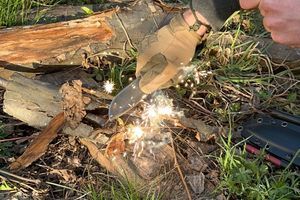
In practice, most of a combat knife's work is tool work: cutting rope, webbing and packaging, opening crates, making kindling, building a shelter, and emergency tasks such as cutting a seatbelt or clothing. Close combat is the last resort. That is why modern designs combine a strong tip with a practical working edge.
Below are the 10 main types of combat knives, what makes each one different and who uses it.
1. Assault knife
The classic front-line knife, built to survive rough field use rather than to look good.
- Blade length: 15–20 cm (6–8 in)
- Thick spine for chopping, prying and even digging
- Often a sawback or serrated section
- Heavy, reinforced handle
Used by: infantry and combat engineers. Example: the KA-BAR USMC, issued to US Marines since World War II.

2. Tactical knife
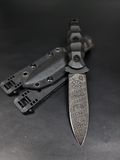
A modern all-rounder that sits between a combat knife and a survival knife. It is meant for patrols, rescue work and emergencies as much as for the field.
- Blade length: 10–18 cm (4–7 in), comfortable for daily carry
- Non-reflective coating, usually black or tan
- Handle made of G10, Micarta or rubber
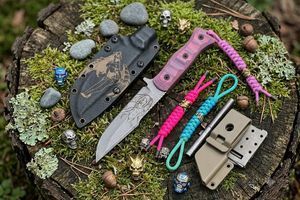
- Lanyard hole and a sheath compatible with MOLLE or Tek-Lok mounts
Used by: soldiers, police, rescuers and outdoor users. Examples: modern fixed blades such as the ESEE-5 or the Benchmade Nimravus.

3. Combat dagger
A close-combat blade with a narrow, symmetrical, double-edged shape built for thrusting.
- Symmetrical blade sharpened on both sides
- Sharp, reinforced point
- Light weight
Used by: special forces and reconnaissance units. Example: the Fairbairn–Sykes fighting knife, carried by British commandos in World War II.

4. Bayonet
A knife that mounts on a rifle and also works as a hand tool.
- Attachment to the rifle barrel
- Often a saw, wire-cutter or other tool features
- Works both as a bayonet and as a utility knife
Used by: riflemen. Examples: the US M7 and M9 bayonets, the AK-74 bayonet.

5. Survival knife
When you are alone in the woods or mountains, this is the knife that has to do everything.
- Thick blade that can chop and baton wood
- Sheath with room for a fire starter, sharpener or paracord
- Ergonomic handle for long work sessions
Used by: soldiers, rescuers, hikers and bushcrafters. Example: the US Pilot Survival Knife, issued to American military aircrews for decades.

6. Karambit
A claw-shaped knife from Southeast Asia with a ring for the index or little finger.
- Curved, claw-like blade
- Finger ring for retention
- Popular in martial arts training
Used by: martial arts practitioners and instructors. Examples: karambits by Fox Knives and Emerson.

7. Tanto
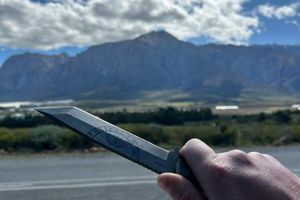
A modern design based on the Japanese tantō. The angular, reinforced tip is extremely strong when piercing tough materials.
- Angled tip with a clear "break" in the edge
- Very strong point
- Straight, easy-to-control edge
Used by: soldiers and fans of Japanese-inspired design. Example: the Cold Steel Recon Tanto.

8. Skeleton knife
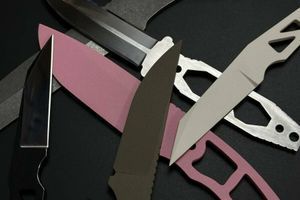
A knife cut from a single piece of steel, without handle scales: light, compact and easy to mount on a vest, belt or bag.
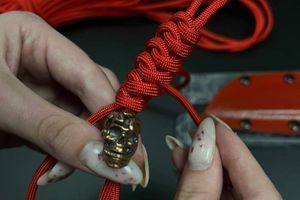
- One-piece steel construction, often wrapped in paracord
- Minimal weight
- Great as a backup or everyday-carry (EDC) knife
Used by: soldiers, combat medics and minimalists. Example: the ESEE Izula.


9. Throwing knife
Built to be thrown, with balance and shape that let it hit a target accurately at short range.
- Even weight distribution
- Smooth shape without hooks
- Often no handle scales
Used for: sport throwing and training.
10. Backup knife (neck or boot knife)
A small knife carried as a spare in case the main one is lost or out of reach.
- Short blade, 5–9 cm (2–3.5 in)
- Fixed or folding
- Quick to draw
Used by: soldiers, security staff and law enforcement. Note: rules on carrying small fixed-blade knives differ widely between US states and countries, so check your local laws.
How to choose a combat knife
There is no single best combat knife. Start with the task, then check five things:
- Blade length. 10–15 cm (4–6 in) covers most tasks; longer blades chop better but are harder to carry. More in our guide to blade length.
- Steel and hardness. Tool steels such as D2 and its close equivalent X12MF, hardened to 58–60 HRC, hold an edge well and stay tough enough not to chip — see D2 vs. X12MF and why 58–60 HRC.
- Construction. A fixed blade with a full tang is stronger than any folder.
- Handle. Micarta and G10 stay grippy when wet — see Micarta vs G10.
- Sheath and mount. Make sure it fits your belt or vest — see our guide to mounting systems.
FAQ
What is the difference between a combat knife and a tactical knife?
A combat knife is designed first for military use, including close combat. A tactical knife is a broader category: a rugged fixed blade for field, rescue and everyday tasks. Many modern knives fit both descriptions.
What blade length is best for a combat knife?
For most people, 10–15 cm (4–6 in). It is long enough for real work and short enough to carry comfortably.
Is it legal to own a combat knife?
In most places owning one is legal, but carrying rules differ by country and, in the US, by state. Check local laws on blade length and concealed carry.
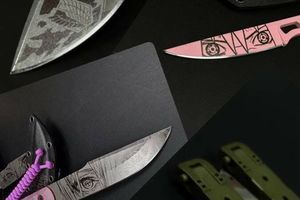
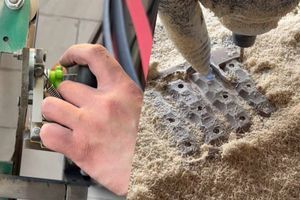
At ProstaSTAL we make tactical, dagger-style, survival, tanto and skeleton knives by hand in our workshop in Khmelnytskyi, Ukraine. See the knives.