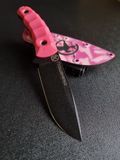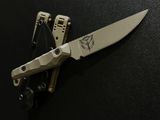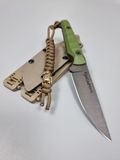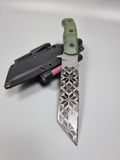

Imagine this: you are deep in the woods. Around you, there are only ancient trees, silence, and the scent of pine needles. The sun is slowly setting, and you need to set up camp before dark. You aren't just "surviving" with your last ounce of strength; you are living here. This is the essence of the bushcraft philosophy: not to fight nature, but to be a part of it.
In this situation, your hand instinctively reaches for your belt. What you pull from your sheath will determine whether your evening is a cozy rest by the fire or a struggle with a dull tool. A knife in the forest is not just an accessory. It is an extension of your arm.
But what should it be—the ideal forest companion? Let’s break it down.
One Solid Piece of Steel — Your Guarantee of Peace of Mind

If you ask an experienced woodsman what is most important in a knife's construction, they will answer with two words: Full Tang.
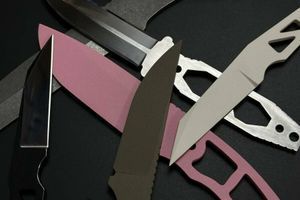
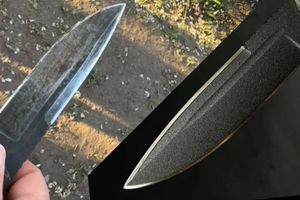
Forget about complex mechanisms and rat-tail tangs that can fail at the most critical moment. A real survival knife is a solid bar of metal running from the tip of the blade to the very end of the handle. The scales are simply screwed or riveted onto the sides.
Why is this critical? Imagine you need to split a dry log to get to the dry heartwood for kindling (a process called batoning). You will be striking the spine of the knife with another log. A standard kitchen or folding knife would simply shatter under such stress. A Full Tang blade will withstand it. This is the margin of safety that gives you peace of mind.
Size Matters: The Golden Mean of 4.7–5.5 Inches (12–14 cm)
There is a myth that for the woods, you need a huge chopper, like in the Rambo movies. Or conversely—a tiny scalpel. The truth, as always, is in the middle.
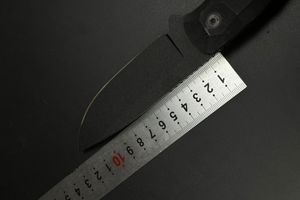
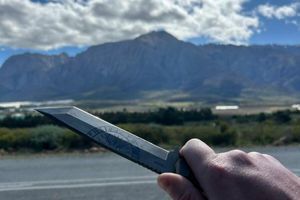
For our forests and tasks, the ideal blade length is 12–14 centimeters (approx. 4.7–5.5 inches).
-
Why not shorter? With a shorter knife, it is difficult to split (baton) a medium-diameter log—there isn't enough blade protruding to strike.
-
Why not longer? Longer knives are hard to control when you need to carve a spoon, a tent peg, or simply peel a potato.
This size makes a camping knife truly universal: it is convenient for both food prep and chopping branches for camouflage or shelter.
Steel: The Heart of Your Tool
We won't give a metallurgy lecture here. The main thing you need to know: the steel must hold an edge for a long time ("aggressive bite") and not be brittle.
We recommend knives made from the time-tested X12MF steel (the closest US analog is D2 tool steel). It behaves excellently in the forest, "bites" into wood, and doesn't get dull after the first whittling job. 👉 (https://prostastal.com/lehovana-stal-kh12mf-d2-kharakterystyky-vlastyvosti-ta-ttkh/)
The Handle: Comfort in Any Weather
A knife should be an extension of your hand, not a slippery bar of soap. In the forest, your hands might be wet from rain, snow, or processing fish.
This is where Micarta takes the stage. It is a material with a unique property: when wet, it doesn't become slippery, but rather "grippy"—its micro-fibers raise slightly, ensuring secure traction with your palm. Additionally, Micarta feels "warm" to the touch, which you will definitely appreciate during winter outings when you have to work without gloves.
The Magic of "Feather Sticks"

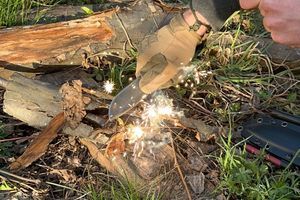
How do you know if you have the right bushcraft knife in front of you? Try making a "feather stick." This is when you don't just whittle a stick, but shave off thin, paper-like curls, leaving them attached to the base to create a "curly" cap.
Such a preparation ignites from the smallest spark of a ferro rod. To make one, you need a sharp, controlled instrument with the correct edge geometry. If your knife can do this—you will never be left without heat.
🛠️ Where to Find a Reliable Tool? Choose Craftsmanship, Not Mass Market
Choosing gear is always a responsibility. When you search for "buy bushcraft knife", you are looking not just for a pretty picture, but for confidence in tomorrow.
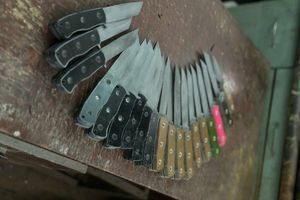
At the ProstaSTAL workshop, we understand the price of reliability. We don't just sell knives—we create tools that have passed the test of real-world conditions.
What do you get by choosing our survival knife?
-
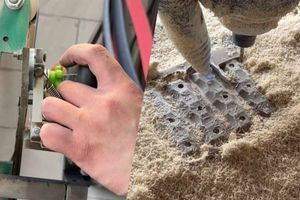
Proven Materials: We work with the same X12MF (D2) steel and Micarta mentioned above. Every blade undergoes proper heat treatment to withstand loads without failing.
-
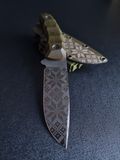
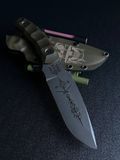
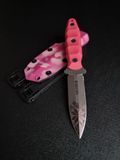
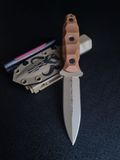
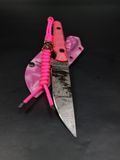
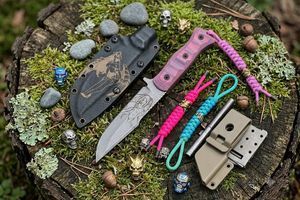
Thoughtful Geometry: Our models, like the legendary "Yarchuk", are created considering the needs of bushcrafters. A comfortable guard, correct blade length, and reliable Full Tang construction make them ideal for forest work.
-
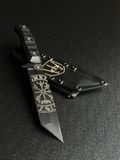
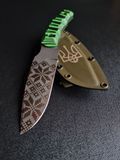
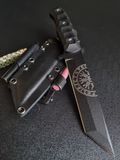
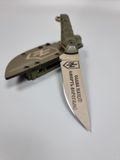
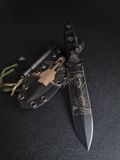
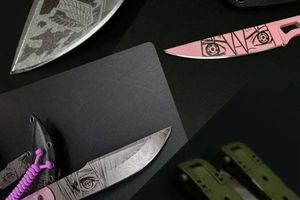
Individuality: Your knife can be unique. We offer laser engraving—from your call sign or initials to complex artistic designs. This turns the tool into a personal artifact or the perfect gift.
-
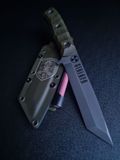
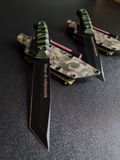
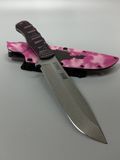
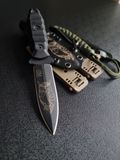
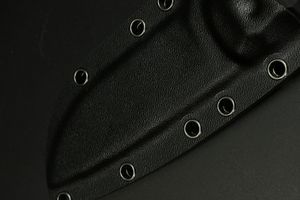
Comprehensive Approach: Our knives come equipped with reliable sheaths (Kydex or Polyamide) with various mounting options so your tool is always at hand.
Don't rely on chance. Choose professional gear created by Ukrainian craftsmen. Order your ideal knife today and be ready for any of nature's challenges.