
Imagine the cold lands of Scandinavia in the harsh Viking Age, where life was a constant struggle. Where every voyage out to sea could be the last, and every battle demanded not only the strength of muscles but also an unbreakable spirit. In such a world, a word, a sign, a symbol—held immense weight. It is an integral part of the rich Scandinavian culture.
Two of these symbols, the Helm of Awe and Vegvisir, have come down to our days without losing their mystical aura. Outwardly similar, their purpose is different. Using the wrong symbol is like going into battle with a travel compass instead of a shield. Each of them is powerful, but only in its own place. Let's delve into their secrets to understand which power is closer to you.
The Helm of Awe (Ægishjálmr): A Power that Inspires Respect

If you could imagine power as a visible object, it would look exactly like this. The Helm of Awe, or Ægishjálmr, is one of the most powerful Icelandic galdrastafir (magical staves). Its aggressive symmetry, where eight trident-like spokes radiate from a central point, carries a clear message: protection through domination.
Its history is inextricably linked with the legend of the dragon Fafnir. Having seized a cursed treasure, Fafnir used the Helm of Awe to appear invincible and to strike terror into the heart of anyone who dared to approach. This symbol was his main weapon, paralyzing the will of his enemies before the battle even began. It is not surprising that this idea was adopted by the Scandinavians of that era—the Vikings, who, according to legends, drew this sign on their helmets and foreheads before a fight to gain the same might.


Often, the Helm of Awe is depicted within a circle, sometimes with runes. This element serves to amplify it: a simple circle creates an additional protective barrier, and a runic circle adds the energy of the entire runic order to the symbol's power, turning it into an all-encompassing shield against any negativity.
In essence, Ægishjálmr is not just a passive amulet. It is a tool for active defense and psychological pressure. Its energy is a gaze that forces retreat; it is an inner core that cannot be broken; it is unyielding determination at a moment when all others doubt.
That is why this symbol resonates in the hearts of warriors in the broadest sense of the word: from soldiers and fighters to people waging their own struggles with life's challenges.
Vegvisir: The Runic Compass that Will Show the Way

If the Helm of Awe is a weapon, then Vegvisir is a map and an amulet in one. Its name comes from the Icelandic language and literally means "wayfinder" or "signpost". Unlike Ægishjálmr, its energy is not directed outward, to suppress an enemy, but inward—to maintain one's own course.
Vegvisir is first mentioned in a 19th-century Icelandic magical manuscript, the Huld Manuscript. It says of it: "He who carries this sign with him will never lose his way in a storm or fog, and will find the way even when the path is unknown."

This powerful definition applies not only to physical journeys. Vegvisir is, above all, a symbol of a spiritual compass. It helps one not to stray from their life path, to remain true to their principles, and to make the right decisions in "foggy" periods of uncertainty. Its power is in navigation, not confrontation. It does not promise victory in battle, but it guarantees that you will reach your destination.
That is why this symbol resonates with travelers, seekers, and those who stand at a crossroads. It is for people who are starting a new stage in life, searching for their calling, or simply need a reminder of where they are going and why. Vegvisir is a quiet and wise guide in the chaos of the modern world.
The Helm of Awe vs. Vegvisir: What to Choose for Yourself?

So, we have two powerful Scandinavian symbols, a legacy of the rich Scandinavian culture. Both come from the same tradition, both have eight spokes, but they serve completely different purposes. To make the right choice, it's enough to ask yourself one simple question: "What kind of support do I need right now?"
Your choice does not depend on which symbol is "stronger" or "better." They are both incredibly powerful. The choice depends on your current stage in life. One is for the warrior going into battle. The other is for the traveler seeking the way.
A Symbol on Steel: How a Legend Becomes a Personal Talisman
When the choice is made, the question arises: how to turn this symbol from an ancient legend into something real, something that will be with you every day?

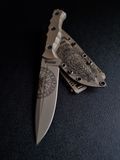
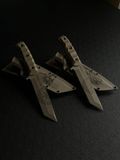
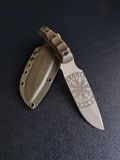
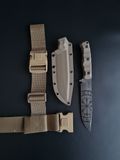
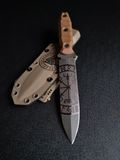
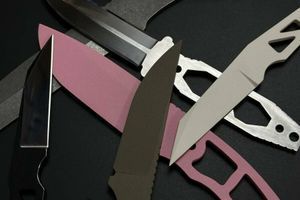
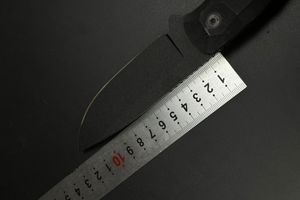
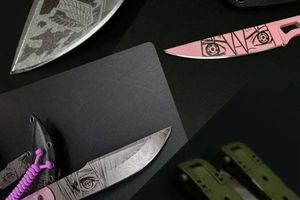
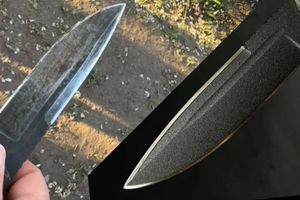
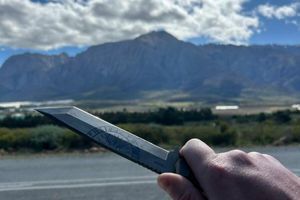
A knife is not just a tool. In the Viking Age, it was the warrior's main companion, a universal tool of the Vikings for hundreds of tasks. The modern Viking knife is not only about the shape but also about this deep connection between the owner and their blade. It is precisely Scandinavian engraving on knives that transforms a quality item into a personal artifact. It is no longer just a blade—it is your story, your intention, your power, embodied in steel.
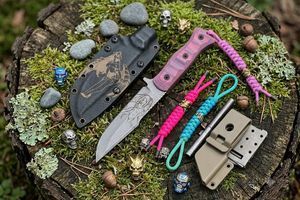
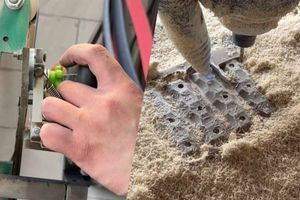
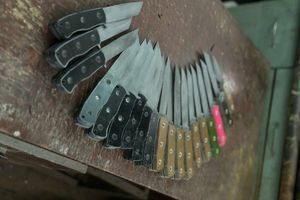
In our workshop, we deeply understand this philosophy. We don't just "make pictures." We create unique custom engraved knives, where every line applied to the blade has its meaning. Our approach is to ensure the symbol not only decorates the knife but lives on it, harmonizing with the shape of the blade and the character of its future owner.

Today, many people want to buy an engraved knife, choosing from ready-made templates. We offer a different path—to create it together. You can be sure that your custom engraved knife will be one of a kind, because its creation will involve not only our craftsmanship but also your personal story.
Feel free to browse our Scandinavian-style collection here
Do you have one of these symbols? Let us know in the comments!