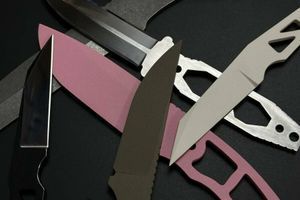

In the harsh world of Norse mythology, symbols were not just stories. They were power, forged in legends and tested in battles. And no power was as coveted as the authority of Odin—the god of wisdom and war, whose signs warriors sought to carry with them, carved on their shields, amulets, and the blades of their knives.
His messengers are the ravens Huginn and Muninn, Thought and Memory. His seal is the enigmatic Valknut, the Knot of the Slain. Together, they form not just separate Viking symbols, but a living legend—a story of how knowledge becomes power, and how power defines destiny.


The high god of the Æsir is a figure not so much royal as he is tragic and relentless in his quest. Odin is not a static ruler on a golden throne, but an eternal wanderer, the god of war and wisdom, whose power was forged not by birthright, but by the cost of incredible sacrifices. His story is a path of self-denial for a single purpose: to comprehend all that was, all that is, and all that will be.

Sacrifices for Wisdom
To understand Odin, one must understand the price he paid. The first great sacrifice was made at the roots of the world tree, Yggdrasil, at Mimir's Well, where all the wisdom of the world was kept. When the Allfather asked for a drink from this spring, its guardian, the giant Mimir, demanded a terrible payment—the eye of the god. Without hesitation, Odin tore out his own eye and dropped it into the well. He surrendered half of his physical sight to gain, in return, an inner vision—the ability to see not the surface of things, but their hidden essence.


But even this was not enough. To grasp the mystery of the runes—magical signs capable of shaping reality itself—Odin sacrificed himself to himself. Pierced by his own spear, without food or water, he hung from a branch of Yggdrasil for nine days and nine nights. It was a shamanic ordeal, a symbolic death and rebirth that gave him access to the deepest secrets of the universe. Odin's power is not a gift, but an achievement. Every drop of his knowledge was paid for with pain. This is a philosophy familiar to anyone who relies not on chance, but on their own readiness and the reliability of their tool, be it a hunting knife in the woods or a tourist knife in the mountains.


The God Who is War
Unlike Thor, whose strength manifests in physical might and the roar of thunder, Odin's belligerence is of a different, far deeper nature. He is not merely a participant in battles; he is their conductor, their poet, and their dark magician. His connection to war is not a duty but his very essence. It is no coincidence that one of his names, Wotan, is linked to the Latin word furor—"fury," "madness".
The very first act of war in the world was committed by him: in the "Völuspá" (The Prophecy of the Seeress), it is said that Odin cast his spear into the host of the rival Vanir gods, and so the first battle began. He does not wait for war—he begins it. His methods are not so much the clash of weapons as they are psychological warfare. He wields the magic of seiðr, which allows him to "bind and unbind" the minds of warriors: to cast panic and helplessness upon his enemies, and to grant his own followers the battle-frenzy of the berserkers.
He is a cunning strategist who revels in the chaos of battle and, as the myths say, could stir up conflicts even between peaceful peoples simply to enjoy the spectacle. This is why he is the god of war. Because for him, war is not just a clash of armies, but the highest expression of will, fate, and magic, which he so desperately seeks to command. He is a cunning strategist who revels in the chaos of battle and, as the myths say, could stir up conflicts even between peaceful peoples simply to enjoy the spectacle. This is why he is the god of war. Because for him, war is not just a clash of armies, but the highest expression of will, fate, and magic, which he so desperately seeks to command. His will was embodied in the blades of his followers, turning an ordinary tactical knife into an instrument of fate.


Lord of Valhalla in Anticipation of the End
And it is this nature as a war god that explains the existence of Valhalla. His hall of the fallen is the logical extension of his command over battle. His messengers, the Valkyries, soar over the battlefield to choose half of the bravest slain warriors. But this is not a reward for courage. It is a strategic preparation for a battle yet to come.
It is crucial to understand: Ragnarök is not a past event, but an inevitable future. It is a prophecy that Odin knows in excruciating detail, and one that leaves no hope for his own survival. He is destined to face the monstrous wolf Fenrir in battle and be devoured by him. But the end is not total annihilation. After the fire and flood that will destroy the old world, a new one will be born, green and beautiful. A few gods, including Odin's resurrected son Baldr, will return to rule this renewed world.

Thus, all of Odin's actions, his gathering of warriors in Valhalla, are not an attempt to save himself. It is a desperate yet noble effort to ensure that after the inevitable doom of the gods, something worthy of salvation remains. He fights not for his own life, but for the future of the world itself. By engraving Odin's symbols on a knife, one can join the fight for the future.
From Myth to Metal: Your Legend, Forged in Steel
But how do these symbols live today? They come alive not on the yellowed pages of sagas, but in the intentions of modern warriors, hunters, and wanderers. They become a part of your personal story. And a blade is the perfect canvas for such a saga.
To place the sign of Odin on steel is to declare your path of wisdom. To choose the ravens is to acknowledge the power of thought and experience. To mark the blade with the Valknut is to accept your destiny with unyielding resolve. This is more than decoration. It is an oath, carved in metal.


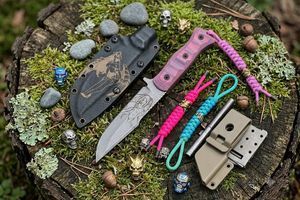
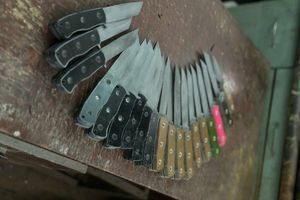
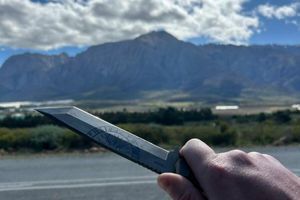
But how do these symbols, forged in myth, find their place on the steel of your knife? A blade is the perfect canvas for such a saga. It is the primal tool, a faithful companion, always at hand. For a warrior, it is a tactical knife that becomes an extension of his will. For a traveler, it is a reliable knife for the woods or bushcraft, that will not fail in the wild. And as a knife as a gift, it is an expression of the deepest respect, a recognition of a person's strength and wisdom.
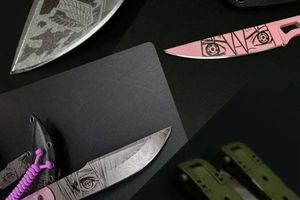
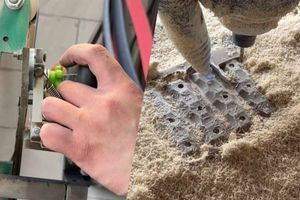
That is why we do not offer ready-made solutions, because your story is unique. We believe that custom engraving is a dialogue. A dialogue between you, the craftsman, and the steel. You bring an idea, an intention, a piece of your soul. We contribute our skill to transform your vision into an eternal sign. Together, we create not just a knife with an engraving. We create a personal artifact. An object that has a soul and tells your story, and yours alone.